

Special Issue Call for Papers – Urban Living Labs and New Epistemologies of Urban Design
January 19, 2026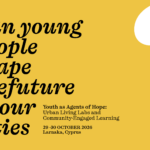
Can young people shape the future of our cities?
October 23, 2026PS-U-GO – Education in Living Labs: Participatory Skills for Sustainable Urban Governance and the AESOP Thematic Group PSUC – Public Spaces and Urban Cultures are pleased to announce the Call for Participation for the International Conference 2026:
Youth as Agents of Hope: Urban Living Labs and Community-Engaged Learning
The conference will take place on 29–30 October 2026 in Larnaka, Cyprus. It is hosted by the Society and Urban Form Lab (SURF), Department of Architecture, University of Cyprus, and supported by Larnaka2030, the European Capital of Culture 2030.
The two-day event brings together the Erasmus+ project PS-U-GO and the AESOP Thematic Group on Public Spaces and Urban Cultures to encourage encounters, exchange and constructive discussion around youth participation, Urban Living Labs, public space and community-engaged learning.
Conference topics
Involving young people in public space and urban governance brings immediate concerns into long-term urban development agendas. Urban Living Labs offer a promising framework for inclusive urban decision-making, fostering collaboration among multiple stakeholders and young people, and creating situated learning environments that bridge formal higher education with engagement in spaces of everyday life.
The conference aims to address the following questions:
- How do young people gain a meaningful role in public space and urban governance?
- What role do Urban Living Labs play in bridging formal education with real-world urban contexts?
- How can participatory methodologies support civic responsibility among students and young urban professionals?
- What pedagogic frameworks best support situated, experiential learning through Urban Living Labs?
- How can students and young people contribute to urban change by co-creating urban solutions and imagining hopeful urban futures?
- What institutional, spatial, and relational practices make Urban Living Labs with young people effective?
Conference format
The conference comprises two days of activities encouraging exchange and collaborative reflection among all participants.
It is organized around roundtable discussions, each structured around one of the conference’s core questions, with a moderator and a discussant. Roundtables bring together diverse participants who will share their work in short interventions of 10–15 minutes, followed by open discussion.
At the end of Day 1, a mobile workshop will take participants into the city to encounter an active Urban Living Lab site in Larnaka, connecting academic discussions with live urban practice. Participants will also have the opportunity to engage onsite with the work of international artists participating in the Creative Europe project MedSea, led by Larnaka2030.
Day 2 will close with a synthesis session drawing together the threads across all roundtables.
The conference is small-scale and limited to approximately 30 participants, allowing for in-depth exchange and collaborative reflection.
Who can participate
The call is open to researchers, educators, students, including early-career researchers, practitioners, youth workers, policymakers and community organizations engaged with:
- Youth participation in urban planning and decision-making;
- Urban Living Labs as educational and governance spaces;
- Participatory and community-engaged pedagogies;
- Situated learning and experiential education in higher education institutions;
- Co-creation, commoning and civic empowerment in urban contexts.
Format of participation
Participants are invited to contribute through short interventions in the form of:
- Oral presentations;
- Visual essays;
- Videos.
Each intervention should last 10–15 minutes.
Contributions may address theoretical, methodological, educational or practice-based perspectives related to the conference themes.
Submissions
Participants are invited to submit abstracts for:
- Paper presentations;
- Practice-based project presentations or proposals;
- Participatory or community-based case studies.
- Abstracts should be 250–300 words and should clearly indicate:
- Title;
- Author(s) and affiliation(s);
- Conference topic addressed;
- Preferred presentation format;
- 4–6 keywords.
Submissions should be sent to:
charalambous.nadia@ucy.ac.cy
mariamshulqamy@gmail.com
Key dates
1 September 2026 — Deadline for participation interests and submissions
15 September 2026 — Participation approvals
29–30 October 2026 — Conference
30 May 2027 — Conference publication
Conference publications
The conference findings, including all presentations and discussions, will be published online following the event. A book of abstracts will also be published prior to the conference. Both publications will have ISBNs.
Fee
There will be no registration fees for the conference.
Participants are responsible for all travel and accommodation costs.
Venue
The conference will take place in Larnaka, Cyprus, hosted by the Society and Urban Form Lab, Department of Architecture, University of Cyprus, and supported by Larnaka2030.
Why Cyprus?
The location of Cyprus in the Eastern Mediterranean offers a unique venue at the confluence of three continents and a multitude of cultures.
SURF at the Department of Architecture, University of Cyprus, in collaboration with Larnaka2030, has developed an active Urban Living Lab in the city of Larnaka, offering participants a live case study for discussion and first-hand exploration during the accompanying city walkshop.
Contact
For further information, please contact:
Nadia Charalambous
charalambous.nadia@ucy.ac.cy
Mariam Schulqamy
mariamshulqamy@gmail.com
Michalis Psaras
psaras.michalis@ucy.ac.cy